- June 17, 2026
- 173 Views
- 0 Comment
-

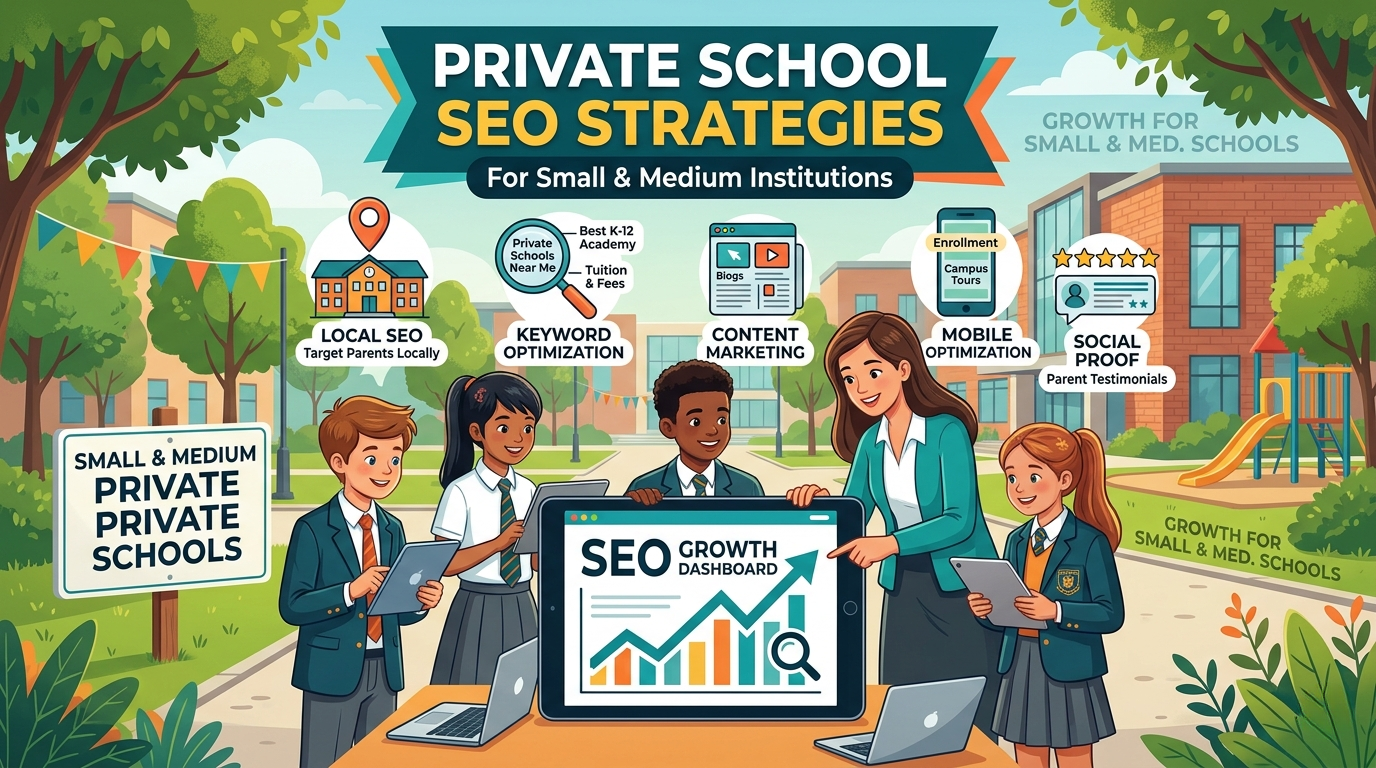
Running a private school is no small task. Between managing staff, handling parent enquiries, overseeing curriculum, and keeping the budget in check, there is barely enough time to think about your school’s website. But here is the thing. If parents cannot find your school on the Internet, all that hard work stays invisible. That is where private school SEO comes in, and it matters more today than it ever has.
The good news is that you do not need a massive budget or a tech team to get started. This guide walks through everything in plain, easy-to-understand language. Real steps, practical advice, and no confusing jargon. Whether you are a principal, a school administrator, or someone managing marketing, this is written for you.
What Is SEO and Why Does It Matter for Your School?
SEO stands for Search Engine Optimisation. In everyday terms, it simply means making your school’s website easier to find on Google. When a parent types “best private school near me” or “independent school with small class sizes in [city],” Google shows them a list of results. The schools that appear at the top of that list get the most clicks, the most enquiries, and ultimately, the most new students.
Proper Private School SEO ensures that when parents are searching for the best educational options, your school is the one that appears in search results. Not a competitor down the road. Not a larger institution with a bigger marketing budget. Your school. The beauty of Private School SEO is that even a small institution with the right strategy can outrank much larger schools online, attract more qualified inquiries, and build stronger visibility within its local community.
Step One: Understand Who You Are Trying to Reach
Before you make any changes to your website or start thinking about keywords, you need a clear picture of your audience. For most private schools, this means local parents who are actively looking for quality education for their children. They have specific needs and specific questions. They want to know if your school is the right fit.
A few questions worth thinking through:
•What ages or year groups are parents searching for?
•What matters most to them? Academics, sports, arts, pastoral care, values?
•Which towns or postcodes are most of your families coming from?
•Are you a day school, a boarding school, or both?
Once you are clear on your audience, the rest of your SEO strategy falls into place much more naturally. You will know what to write about, which keywords to use, and which pages on your website need the most attention.
On-Page SEO: Making Every Page Work Harder
Choose and Use Keywords Thoughtfully
Keywords are the exact words and phrases parents type into Google. For private schools, these might include things like “independent primary school in [town],” “best private school for girls,” or “business school SEO programme.” These phrases should appear naturally throughout your website, in headings, in paragraph text, in page titles, and in image descriptions.
The most important rule here is to write for people, not for search engines. A page stuffed with repeated keywords reads awkwardly and puts parents off. Google is intelligent enough to understand the context of your content. If it reads naturally to a parent, it will almost always read well to Google too. Write honestly about what makes your school special, and include relevant phrases where they fit naturally.
Optimise Each Key Page on Your Website
Every important page on your website should be individually optimised. Your homepage, admissions page, about us page, curriculum page, and fees page are all worth reviewing. For each one, check that you have:
•A clear main heading that naturally includes a relevant keyword
•A short meta description that accurately describes what the page is about
•Well-written, useful content that answers the questions parents actually have
•Images with descriptive alt text labels that tell Google what the image shows
These details might seem small, but they add up. Each one gives Google a clearer picture of what your page is about and who it is relevant to.
Mobile-Friendly Websites Are Non-Negotiable
If there is one thing that absolutely has to be right, it is how your website performs on a mobile phone. The majority of parents today search on their phones, not on a desktop computer. If your website is difficult to read, slow to load, or awkward to navigate on a small screen, most people will leave within seconds. Google tracks this and penalises websites that provide a poor mobile experience with lower rankings. This is why mobile usability is a critical part of Private School SEO. Check your website on your own phone right now. If it does not feel smooth and easy, that is your first priority to fix.
Local SEO: The Biggest Opportunity for Smaller Schools
If you are running a small or medium private school, local SEO is your single most powerful tool. It is the art of making sure your school appears prominently when someone in your area searches for a school. And a great deal of it costs absolutely nothing to set up.
Complete Your Google Business Profile in Full
Google Business Profile is a free listing that places your school on Google Maps and in the local results panel that appears at the top of many school-related searches. Claiming and completing this profile is the single most impactful free thing you can do for your school’s visibility right now.
Fill in every field. Add your full address, phone number, school hours, website link, a brief and honest description of your school, and several good quality photos of your buildings, classrooms, sports facilities, and grounds. The more complete your listing, the more likely Google is to show it to local parents.
Build a Collection of Honest Parent Reviews
Parent reviews on Google are worth their weight in gold. They build trust with new families and help your school rank higher in local search results. The simplest approach is to ask directly. After a positive open day, after enrolment, or at the end of a strong school year, send a short, friendly message to parents asking if they would be willing to leave a review.
Always respond to every review you receive. A warm, professional response to a positive review shows you appreciate your community. A calm and constructive response to a critical one shows you take feedback seriously. Both types of response build your school’s reputation with parents who are reading them.
Use Your Location Throughout Your Website Content
Mention your city, town, and surrounding areas naturally within your website pages. For example: “Our private school in York has been educating children since 1987.” Or: “Families from across Leeds, Harrogate, and Wetherby choose us for our outstanding pastoral care.” These natural mentions help Google understand exactly where your school is and connect it to relevant local searches.
Content Marketing: Bring Parents to You Before They Even Know Your Name
One of the most consistently effective strategies in SEO is publishing helpful, well-written content on a regular basis. Blog posts, guides, and articles that answer real parent questions do two things at once. They bring new visitors to your website who were searching for information, not specifically for your school. And they position your school as a knowledgeable, trustworthy institution before a parent has ever stepped through your gates.
Practical content ideas that work well for private schools:
•“How to choose the right private school: a parent’s guide”
•“What questions should I ask on a school open day?”
•“The real benefits of smaller class sizes for your child”
•“What is the difference between independent and state schools?”
None of these topics mention your school by name, but they bring the right kind of parent to your website. Once they are there and find the content helpful, they naturally explore your admissions page, your fees, and your school philosophy. That is how content marketing quietly feeds your admissions pipeline month after month.
Why Professional School SEO Services Make a Real Difference
You can do a great deal of SEO yourself, especially once you understand the fundamentals. But doing it properly, consistently, and at a level that delivers strong results takes time and ongoing expertise. Most school administrators and principals simply do not have hours each week to dedicate to this. That is exactly why many growing institutions turn to dedicated school SEO services.
A reputable private school SEO agency will begin by auditing your current website to understand exactly where you stand and what is holding you back. They will research the most effective keywords for your school, your location, and your specific programmes. If you offer specialist courses in commerce or management, a team with experience in business school SEO will know how to make those programmes visible to the families searching for them.
Beyond keywords and content, a good agency handles the technical side of things, builds quality links back to your website from trusted sources, and provides regular progress reports so you always know what is working. You do not need to be the biggest school to compete. You just need the right strategy and support. A specialist agency that understands education marketing will know exactly how to position your school to attract the right families. Investing in private school SEO services is one of the smartest long-term decisions a growing institution can make.
Technical SEO: The Foundation Everything Else Rests On
Technical SEO refers to the behind-the-scenes health of your website. You do not need to understand the code to appreciate why it matters. If your website has technical problems, Google will struggle to crawl and index your pages properly, which means lower rankings regardless of how good your content is.
The key technical checks every school website should pass:
•Pages load in under three seconds on both desktop and mobile
•No broken links or pages returning errors
•Your website has an SSL security certificate (the padlock symbol in the browser)
•Your site structure is logical and easy for both parents and Google to navigate
Even excellent content can be dragged down by technical problems. A quick technical audit, which any credible private school SEO agency will offer as part of their service, will reveal issues you may not even know are there.
How to Track Whether Your SEO Is Actually Working
SEO is a medium to long-term investment. Most schools start seeing clear improvements within three to six months. But it is important to measure progress from the beginning so you know what is working and where to focus your energy.
Two free tools that every school should set up immediately:
•Google Analytics: Shows how many people visit your website, which pages they look at, and how long they stay on each one
•Google Search Console: Shows which search terms are bringing people to your site and how individual pages are performing in Google results
The real-world signals matter just as much. Are more parents calling to ask about admissions? Are open day bookings increasing? Is your inbox receiving more enquiries? These are the outcomes that SEO is ultimately working towards. Track them alongside your website data for a complete picture.
Conclusion
Private school SEO is not a luxury reserved for large institutions with deep pockets. It is one of the most practical, effective, and affordable ways to grow any school that is serious about its future. When parents search for a school like yours, you deserve to be the one they find. You deserve to be the school they call, visit, and ultimately choose.
Whether you handle it step by step yourself or bring in specialist private school SEO services to accelerate your results, what matters most is that you start. Set up your Google Business Profile today. Review your homepage on a mobile phone. Write one helpful article for parents this month. These are not big, complicated tasks. They are the small, consistent actions that build real, lasting online visibility.
Good SEO for a school website does not happen overnight. But when it is done right, it keeps working for you around the clock, every day of the year, bringing the right families to your door. At VM RankUp Provide SEO Services, we help small and medium private schools build strong SEO foundations that deliver long-term results. For schools that are willing to invest the time and effort, the rewards are absolutely worth it.
Frequently Asked Questions
1. How long does it take for private school SEO to produce results?
Most schools begin to see meaningful improvements in website traffic and enquiry volumes within three to six months of consistent SEO work. The exact timeline depends on your starting point, how competitive your local market is, and how actively you are working on it. SEO is not a quick fix, but the results it produces are durable and continue to grow over time. A school that starts today will be in a significantly stronger position a year from now.
2. Do small private schools really need a dedicated SEO agency?
Not necessarily, especially if you are starting with the basics and have someone on your team who can dedicate a few hours each week. Setting up Google Business Profile, creating helpful content, and making your website mobile-friendly can all be handled in-house. However, if you want stronger results, faster progress, or help with the more technical side of things, a specialist private school SEO agency with education sector experience is a worthwhile investment.
3. What is the most important SEO priority for a smaller private school?
Local SEO is by far the most impactful starting point for smaller schools. Completing your Google Business Profile, collecting genuine parent reviews, and weaving your location into your website content will produce the fastest and most visible results. Parents in your area searching for schools need to find you. Once that local visibility is established, you can build from there with content marketing, technical improvements, and broader keyword strategy.
4. How much do school SEO services typically cost?
Costs vary considerably based on the scope of work and the provider. Entry-level monthly packages from a reliable school SEO services provider might begin from a few hundred pounds or dollars per month. More comprehensive packages covering content creation, technical optimisation, and link building will be priced higher. The best way to evaluate cost is to think about return. If better Private School SEO helps bring in two or three additional students per year, the service almost always pays for itself many times over.
5. Can a small private school genuinely compete with bigger schools in Google search results?
Absolutely, and this is one of the most encouraging things about SEO. Size does not automatically win in search results. A smaller school with a well-optimised website, strong local SEO, and regularly updated helpful content can and frequently does outrank a much larger school that has neglected its online presence. Your school’s unique identity, values, and specialist strengths are powerful differentiators. Good SEO simply makes sure the right parents discover them.