

Think about how people buy a sofa today. They don’t walk into the first shop they see. They pick up their phone, type “grey sectional sofa near me” or “solid wood dining table under $500,” and start scrolling. If your store does not show up on that first page, most of those buyers will never know you exist.
That is why SEO for furniture website owners is no longer optional. Good search rankings bring you people who already want to buy, and you do not pay for every click as you do with ads. In this guide, I will walk you through what actually works, in plain words, so you can start making changes this week. Whether you run a small local shop or a big online store, solid SEO for furniture website projects can bring in steady sales month after month.
Why SEO for Furniture Website Owners Matters So Much
Furniture is not an impulse buy. People spend days, sometimes weeks, researching before they pay. They compare styles, check prices, read reviews, and study photos from every angle. Every one of those steps happens on Google.
That long buying journey is good news for you, because it gives you many chances to show up. Someone might first search “how to choose a sofa for a small living room,” then “best 3 seater sofa,” and finally “buy fabric sofa online.” If your site has a helpful page for each moment, you meet the buyer at every stage.
Paid ads stop the minute you stop paying. Good rankings keep working. That is why SEO for furniture website projects often return more than almost any other marketing channel over time. Whether you call it furniture store SEO or SEO for furniture business growth, the goal is the same: be easy to find when someone is ready to buy.
Start With Keyword Research That Matches Buyer Intent
Keywords are the words people type into Google. Before you change anything, find out which words your buyers really use. This is the base of all furniture website SEO.
Know the Three Types of Furniture Keywords
Some keywords bring readers, and some bring buyers. Here is an easy way to sort them.
- Buying keywords: “buy king size bed online,” “teak wood wardrobe price.” These people are ready to spend. Use them on product and category pages.
- Research keywords: “best wood for dining table,” “how to clean a leather sofa.” These people are still learning. Use them in blog posts.
- Local keywords: “furniture shop near me,” “sofa showroom in (City name).” These people want to visit. Use them on location pages and your Google Business Profile.
A strong plan for SEO for furniture website growth uses all three types, because each one plays a different part in your sales.
Where to Find Good Keywords
You do not need pricey tools to begin. Try these:
- Google autocomplete. Type a product name and note what Google suggests.
- “People also ask” boxes. These show real questions from real buyers.
- Google Search Console. It shows the exact words people used to reach your site.
- Competitor pages. See what top furniture stores write about and how they word their titles.
Put your findings in a simple sheet. List the keyword, the page it belongs to, and how often people search for it. Give each page one main keyword and a few close helpers. Never push the same keyword on ten pages, or your own pages will fight each other.
Build a Clean Website Structure
Google needs to understand your site, and so do your visitors. Think of your site like a showroom. The front door is your homepage. Then come big sections like Living Room, Bedroom, and Dining. Inside those are smaller areas like Sofas, Beds, and Tables. Inside those are the products.
Your site should follow the same flow: Homepage > Category > Subcategory > Product
A few simple rules help:
- Keep every important page within three clicks of the homepage.
- Use short, clean URLs like /living-room/sofas/ instead of /product?id=4482&cat=12.
- Add breadcrumbs, those little trails at the top that say Home > Sofas > Fabric Sofas.
- Link related pages together. A dining table page can link to matching chairs and benches.
This setup makes furniture ecommerce SEO much easier, because every page has a clear place and purpose. A tidy structure is also the quiet hero of SEO for furniture website success.
Furniture Product Page Optimization
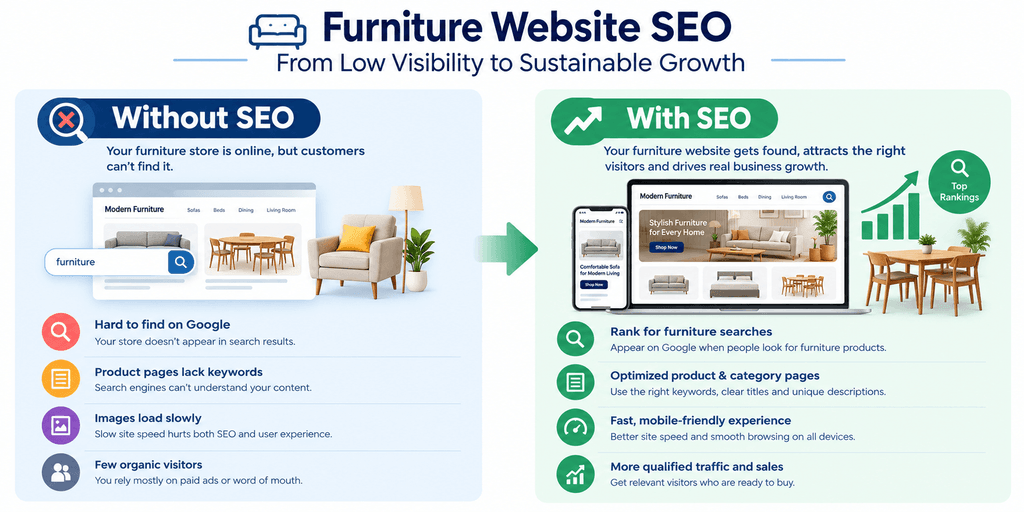
Your product pages are where money changes hands. If you only have time to fix one area, fix these. Good furniture product page optimization lifts both your rankings and your sales at the same time, and it is the heart of SEO for furniture website work.
Write Clear Titles and URLs
A product title should tell people what the item is in a few words. Compare these two:
- Bad: “Luxury Comfort Series Model 77”
- Good: “Solid Sheesham Wood 6 Seater Dining Table Set”
The second one names the material, the size, and the type. That is what people search for. Keep the URL short and match it to the product name, like /sheesham-wood-6-seater-dining-table/.
Write Descriptions That Sound Like a Real Person
Many furniture sites copy the maker’s description. That same text sits on fifty other websites, so Google has no reason to rank yours higher. Write your own, and answer what a buyer wants to know:
- What is it made of?
- What are the exact measurements?
- How many people can it seat?
- How hard is it to put together?
- How do you clean it?
- What are the warranty and return rules?
Write as if you were standing next to the customer in your shop. Keep sentences short. Skip fancy words like “unparalleled elegance.” Say “the cushions are firm but not hard, so you will not sink in.”
Use Great Photos and Videos
People will not buy furniture they cannot see clearly. Show each item from the front, side, and back. Add close-ups of the wood grain or fabric. Include a photo of the piece inside a real room so buyers can judge the size.
For every image, do three small things:
- Name the file clearly, like grey-fabric-3-seater-sofa.jpg, not IMG_8821.jpg.
- Add alt text that describes the picture in plain words.
- Compress the file so it loads fast.
Show Reviews and Add Schema Markup
Reviews build trust, and trust sells furniture. Ask every buyer to leave a review after delivery, and show them on the product page. Then add schema markup, a small piece of code that helps Google understand your page. With product schema, your search listing can show the price, stock status, and star rating. That makes your result stand out and earn more clicks. Shopify and WooCommerce both have plugins that handle this for you.
Optimize Your Category Pages
Category pages often rank best, because people search broad terms like “corner sofas” or “study tables.” Yet many stores leave these pages as a bare grid of products.
Do better. Add a short intro of 100 to 200 words. Explain what the category covers, who it suits, and what to look for when buying. Use your main keyword naturally once or twice. This small step adds real power to your SEO for furniture website plan. Add filters for size, color, material, and price so shoppers can narrow things down fast.
Be careful, though. If every filter combination makes a new URL, you can end up with thousands of near-copy pages. Ask your developer to keep those out of Google’s index, or use canonical tags to point to the main version.
Technical Basics for Furniture Ecommerce SEO
Great content will not help if your site is slow or broken. These checks matter a lot for furniture ecommerce SEO, because furniture sites carry heavy images and big catalogs. Technical health also holds up every other part of SEO for furniture website work.
Make Your Site Fast
People leave slow sites. To speed yours up:
- Compress images and use modern formats like WebP.
- Turn on lazy loading so images load as people scroll.
- Use good hosting and a content delivery network.
- Remove plugins you do not use.
Test your speed for free with Google PageSpeed Insights.
Work Well on Mobile
Most furniture searches now happen on phones. Check that menus are easy to tap, text is readable, and checkout is simple. If a buyer has to pinch and zoom to see a product, they will leave.
Handle Variants and Sold-Out Items Smartly
One sofa may come in six colors. If each color has its own page with the same text, Google sees duplicates. Keep one main page and let buyers pick the color on it. If you must keep separate pages, use canonical tags.
When an item sells out, do not delete the page. That throws away the ranking it earned. Mark it out of stock and suggest similar items. If the product is gone for good, redirect the page to the closest category.
Local SEO for Furniture Stores
If you have a physical shop, this section can bring walk-in customers fast. Local SEO for furniture stores helps you appear when people nearby search for what you sell. Shoppers like to sit on a sofa or press a mattress before paying, so many will visit a showroom if they can find one. Furniture store SEO at the local level is simple, and it works well beside your main SEO for furniture website plan.
Set Up Your Google Business Profile
This is the most important local step, and it is free. Claim your profile and fill in every field:
- Correct shop name, address, and phone number
- Opening hours, including holidays
- The right categories, such as “Furniture store” and “Sofa store”
- Plenty of real photos of your showroom and products
- A link to your website
Post updates about new arrivals and offers once a week, and answer questions people ask on your profile.
Collect and Reply to Reviews
Reviews are a big local ranking factor. After each delivery, send a short message with your review link. Reply to every review, good or bad. A calm, polite reply to a bad review often earns more trust than a perfect rating.
Keep Your Details the Same Everywhere
Your name, address, and phone number should match across your website, Google, Facebook, Instagram, and Business Platform. Small differences confuse search engines. This is called NAP consistency.
Create Helpful Content That Brings Buyers
A blog reaches people early in their search. Think about the questions your shop staff answer every day. Those are your blog topics. Some ideas:
- “How to Measure Your Room Before Buying a Sofa”
- “Sheesham vs Teak vs Mango Wood: Which Is Better?”
- “How to Clean Fabric, Leather, and Wooden Furniture”
Write the way you talk to a friend. Use short paragraphs and simple lists. At the end of each post, link to the products you mentioned so readers can move from learning to buying. Buying guides and comparison posts are some of the strongest parts of any SEO for furniture website strategy.
Build Links From Other Websites
Links from trusted sites tell Google your store is worth ranking. You do not need hundreds. A few good ones beat many weak ones. Links are a big part of furniture website SEO. Try these:
- Local press and blogs. Offer a story or sponsor a local event.
- Interior designers and architects. Offer trade pricing. They often link to suppliers they trust.
- Decor bloggers. Send a product for an honest review.
Skip cheap link packages. They can get your site penalized, and that hurts your SEO for furniture website goals.
Track Your Results and Keep Improving
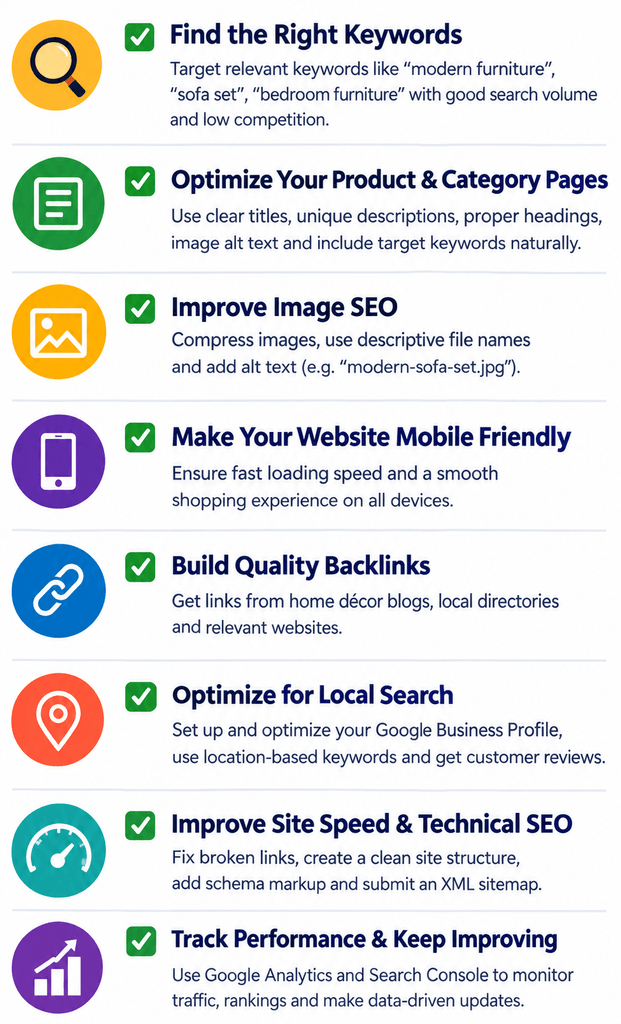
SEO is not a one-time job. Set up Google Analytics and Google Search Console, both free. Every month, check how many people arrive from search, which pages bring the most visitors, which keywords are rising, how many visitors buy, and how many calls and direction requests come from your Google Business Profile.
If a page gets visitors but no sales, fix the photos, price, or description. If it gets no visitors, it likely needs better keywords or more links. Give changes two to three months before judging them. Tracking is how you know your SEO for furniture website plan is paying off.
Common Mistakes to Avoid
Many stores weaken their SEO for furniture website efforts with the same few errors:
- Copying maker descriptions. Write your own.
- Stuffing keywords. Repeating a phrase again and again reads badly and can hurt you.
- Ignoring mobile users. Most of your visitors are on phones.
- Skipping Google Business Profile. You lose easy local traffic.
- Expecting results in a week. Plan for steady progress over months.
Conclusion
Getting more sales from search is not magic. It comes from doing the basics well, for a long time. Know what your buyers type. Build a clean site. Write product pages that answer real questions. Take care of your local presence. Publish helpful content. Earn a few good links. Then check your numbers and keep improving.
The stores that win online are not always the biggest. They are the ones that make it easy to be found, trusted, and bought from. If you follow the steps in this guide, SEO for furniture website growth can become your most reliable source of new customers, and SEO for furniture business owners of any size can use it. Start with one change today, like your top ten product pages or your Google Business Profile, and build from there.
Frequently Asked Questions
1. How long does SEO for furniture website take to show results?
Most stores see small gains in about three months and stronger results between six and twelve months. It depends on your competition, your site health, and how steady you are. Local searches often move faster than national ones.
2. What should I optimize first?
Start with your best-selling product pages and main category pages. They already attract buyers, so small fixes can bring quick gains. Then set up your Google Business Profile if you have a physical store.
3. Do I need a blog for SEO for furniture website growth?
You can rank without one, but a blog gives you a big edge. It reaches people who are still researching and builds trust.
4. How many keywords should I use on one product page?
Pick one main keyword and two or three close variations. Use them naturally in the title, headings, description, and image alt text. If a sentence sounds odd when you read it aloud, rewrite it.
5. Is local SEO worth it if I sell mostly online?
Yes, if you have any showroom, shop, or warehouse people can visit. Many shoppers want to see furniture in person first. Even online-only stores can build useful pages for the cities they deliver to.
6. How can I stop duplicate content from hurting my SEO for furniture website pages?
Write unique descriptions for every product. Use canonical tags for color and size variants. Keep extra filter and sorting pages out of Google’s index.
7. Should I hire an expert or handle SEO for furniture website pages myself?
You can handle the basics yourself, like your Google Business Profile, product descriptions, and reviews. Technical fixes, link building, and large catalogs often need an expert. A good middle path is to learn the basics first, then hire help for the hard parts so you can judge their work.